Earlier this year David Chapman had a particularly concrete post demonstrating the importance of Kegan's developmental levels, which makes for a good test of understanding, and which shows the relevance to important things in life. Like, (not) getting seduced by a witch and turning your whole life upside down when unable to make sense of it.1 You know, stuff that can happen to anyone.
And that got me thinking...
I can see where he's going with that example and yeah that tracks the theory as I understand it. But there are some things I don't feel like the model covers well — or at least, my relatively uninformed understanding of the model doesn't cover well.
First, I'm gonna try to reconstruct what I can from my own way of thinking about things. The following is not Kegan's depiction, it's as close as I can get reconstructing it from what makes sense to me:
- At stage one you just act on impulses and that's it. But impulses often conflict with each other. You can eat when you're hungry and pull away from things that are pokey when hurty, but if you have to grab pokey animal in order to eat then you're being torn in two conflicting directions with no perspective from which to mediate this conflict, so this becomes a crisis.
- At stage two you can take impulses as object and sit with conflicting impulses as you at least try to align your impulses towards your self interest. This is alignment on the individual human scale. But individual humans often conflict with each other. You can take a few porcupine quills in order to eat, but if you need to split a kill with another human this is a crisis because you two have a conflict with no perspective from which to mediate.
- At three you can take self interests as object and at least try to align your interests towards a relationship with another. This is alignment on the pair bonding level. But human dyads conflict with other dyads. You can build a marriage through sacrifice of individual interest, but when you find yourself loving Maya too this is a crisis. You can figure out how much to trust your brother about how to grow crops, but if everyone has a different idea you have no method of making sense of this madness.
- At four you can take dyadic relationships as object and work towards alignment between dyads. Maybe a better word than "system" here is "culture"? You can sacrifice your love for Maya because in this culture we do monogamy, but when she explains why polyamory is common in her culture you six minute abs. You can figure out who to believe by subjecting hypotheses to Science, but when the science contradicts your lying eyes, you're now faced with a conflict between systems of belief formation without a perspective from which to mediate, so this is what can kick your ass.
- At five you can take systems/culture as object, and work towards alignment on this scale as well. You can hold your culture's sacred idols lightly, and sacrifice them when needed. Maybe you eat babies on your diplomatic visit with the aliens that are threatening to destroy life, or maybe just in your interactions with the lizard people running the US government or whatever.
Maybe it stops there, because once you can align groups of groups of people, they just become groups of people? Maybe there are larger structures of organizations that nevertheless persist due to differences in what's locally appropriate, and you can therefore have egregoric dyads and larger structures or something?
The big divergence between my description and Kegan's starts where I ended describing stage 3 as about being subject to dyadic relationships and stage 4 about making these object in serving larger group coordination. Kegan calls stage 3 about "relationships" without this distinction, and stage 4 is when you transcend external validation and "self author" a "system".
I'm not buying it though, because as anyone who has ever met anyone insecure will know, "pre-systematic" people will absolutely create their own internal judgements of themselves. The judgement may be framed as "What other people would/should think", but the little tulpa of society is internally generated nonetheless. Similarly, stage 4 people coincidentally all "self author" into the same kind of systems as their peers. They may frame things as "I make up my own mind", but the way in which they make up their own mind — the "system" that they follow — still came from the outside. So "external" vs "internal" doesn't do anything for us. It's just about the size of the system being aligned to. Relationships between individuals or relationships between relationships.
This brings up an interesting puzzle because by my thinking, identifying with ones community seems like it ought to require stage 4, but Kegan crams it all into 3 with an undifferentiated "relationships" — and intuitively, Kegan is right on this one. I think the resolution here is that at stage 3 you relate to "your community" as if it were an individual itself rather than an interaction between many individuals. The "stage 3" people who are prioritizing their culture over individual relationships are genuinely doing so out of stage 3 attachments to dyadic relationships, it's just that they're married to the egregore, and this marriage can be more important to them than the marriage to their human spouse, their relationship with their parents/etc. Christians use this language explicitly when they talk about being "Married to Jesus". In the extreme, this collapses all n² relationships and all their potential conflicts into three mutually compatible relationships. There's the marriage to Jesus, relationships to fungible sister wives, and the null relationship with heathens. And anything difficult can just be kicked into the latter category. You're not a real Christian, or whatever.
The egregoric marriage facilitates coordination with larger structures of people without having to pay the computational complexity cost of navigating multiple contradictory relationships by forcing relationships into standardized form. The egregore may demand faithfulness and primary status, but is a bit poly, I guess.
Another complication is that according to the standard Kegan take at stage 2 you can split a kill for the purpose of not killing each other. You can also share your kills so that they share theirs. You just can't do it because you care about other people intrinsically. It's about the motivation not the behavior, yeah yeah.
But this highlights an issue:
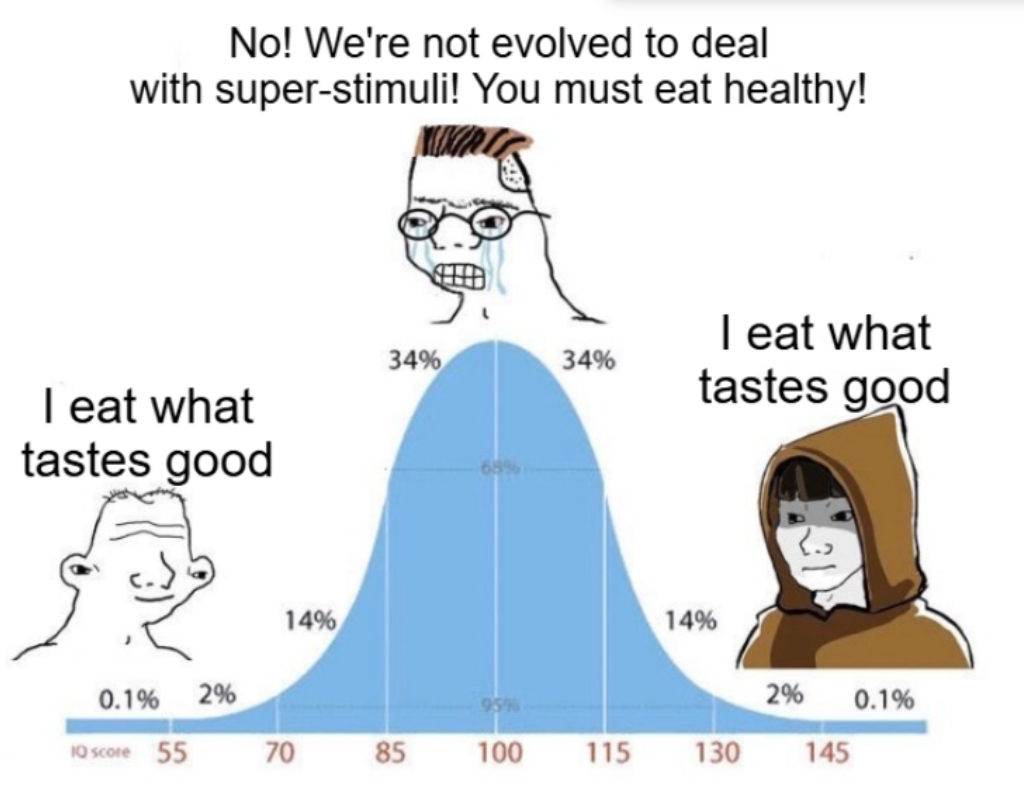
The simpleton is stage 1 because they're owned by their tastes. Midwit is doing stage 2 because they can hold their tastes as object and disagree. The Sage is back to following impulses because they've aligned their impulses with their self interest and no longer have conflicts that require stage 2 dissociation from their impulses. Either because he lucked out in a lottery of tastes, or because he used his ability to do stage 2 to resolve the misalignment that required stage 2 in the first place. Healthy food tastes good.
The generalizable thing is that when your lower levels are well adjusted, the conflict that necessitates more complex perspective holding doesn't exist.
- Pay attention to the interactions between your impulses and self interest, and it no longer requires holding self interest as distinct from impulses, because they're in alignment. Liver is yummy. Massages hurt in a good way.
- Pay attention to the interactions between your self interest and the interest of your relationships, and you no longer have to sacrifice your self interests for your relationships. You want to give your spouse a back massage, and don't have to work through the math of "Ugh, but I should because then they'll rub my back!" each time, because you've got a cognitive shortcut of "relationships matter, dummy".
And so on and so forth.
From this perspective, the one with the most sophisticated development isn't the one "holding systems lightly". That guy is the fool who isn't good enough at stage 4 systematization to have found one that can handle life to acceptable precision. The one with the sophisticated development is the one who has been there, done that, and crafted a system that actually works for creating relationships that work for satisfying self interests which work for satisfying impulses.
So maybe the guy operating at stage N+1 isn't more developed than the guy operating at stage N. Maybe he's less developed because his stage N skill are failing him whereas the stage N guy has actually put in the development — maybe at stage N+1, even — to get stage N to work for him. Or maybe he hasn't, and it isn't, and they're both failing at stage N. In which case, maybe the one that's more developed is the one who is noticing this and stepping back to N+1 so that they'll have a shot at resolving it.2
So it's not just "Can't look at the behavior in isolation, must look at motivations", it's something closer to "Can't look at motivations in isolation, must look at meta-motivations". Which are hard to see except in their absence, when they don't mesh with reality. Must look at persistent misalignments. The guy stuck at one is the guy who can't figure out how to eat the pokey animal without the pokey causing great suffering, not the guy who eats when hungry, because hungry.
But if we're looking at limitations now, then where do those come from? I don't think it's just one thing.
For example, there's the fish that doesn't know what water is. You say "That stuff you're swimming in", and the fish is just confused. Having never seen not-water, it's hard to figure out what is. However, this fish also doesn't need the concept of water, because it's not like he's gonna run out of it any time soon. If all your impulses line up with your perception of self interest — liver tastes good, massages feel good, massaging your spouse feels good etc — then "wtf is willpower?" isn't a problem. It's only when you gotta do something you don't wanna that it actually matters, and at that point it's the most salient thing in the world. Take a fish out of water, and all of a sudden fishy will know what you're talking about when you say "Water is the thing you're missing right now". It's gonna be confusing at first, because you have to construct a concept of "Doing what I don't want, because I wanna do what I don't want" which is inherently contradictory until you build better distinctions, but you'll know when you need to do it.
Another kind of limitation — which I think is beneath all the actual problems that being insufficiently developed causes — is where you get smacked in the face with your current limitations and then turn to "No, it is the children reality that is wrong". In Chapman's story, James gets witch-slapped with the fact that his way of relating to things isn't working, but instead of "Oh, neat!" — noticing that he did succeed in staying faithful to his wife, doing gratitude about the fact that he managed to rise to the occasion when surprised with reality being other than what he modeled, and getting curious about what he's missing that made it a close call — it was crushing to him. He ran away. First literally, then he quit his job. Didn't tell his wife, etc.
This decision to turn away from reality is eminently understandable, as we've all done it. All do it. I argue that it's rational, even when we're able to predict that we're too stupid to face reality without updating in ways that bring us further from a usefully true interpretation of the new information. At the same time, this is the sticking point, and if James had had higher skill in sitting with discomforting uncertainty without acting on what he cannot yet ground, he could have learned a lot faster, speed run a 3 to 4 developmental stage transition, and kept his job. And been a better husband through the whole thing, to boot — which is supposed to be what stage 3 is all about anyway.
I've talked elsewhere about what can be done about insecurity to help people update faster safely, but here I want to note that I don't think these two kinds of limitation are actually orthogonal.
The conversation between Dr. Mike and Dr. K is a perfect example of this. Dr. Mike comes off as an intelligent and epistemically humble and curious person stuck in stage 4. And so even though Dr. K isn't pushing woo at him, and isn't doing anything objectively that should frustrate Dr. Mike (from Dr. Mike's own POV), Dr. Mike gets frustrated just because up against the limits of organizational complexity he's familiar with responding to. It's like throwing a wrestler into the jiu jitsu room, in that it's "Wtf is this?" and there's low demonstrated skill purely out of lack of experience.
On that hand, it's "Fish, being introduced to not-water, finding his footing".
On the other, non-transient frustration is proof of insecurity. It demonstrates a flinch from reality. A decision Dr. Mike is implicitly making to not do humility and sit with his evidenced wrongness, which is fundamentally a failure of arrogance. Coming from a normally humble individual, who definitely doesn't see arrogance as okay or something worth allowing in himself, because he simply doesn't see it. I feel fondly about Dr. Mike and don't say this out of criticism, as I'm sure he'd come around and update his impulses if he recognized them and knew what to do with them — which is all that can be asked of anyone in the first place. Both causes are significant here, because he's demonstrating insecurity AND that's what happens when you take people so quickly to such unfamiliar grounds, and he's handling it quite well all things considered.
And then there's examples where people are operating at a lower level than they could, not because they don't have the concept, and not because they're subject to their own insecurity, and not because the problem is completely solved at this level, but because they're aware of the computational price to pay and just don't think it's worth it in this context. After reading the Maya story, I was able to think of an experience of my own which had some qualitative similarities and could be told as an example of a developmental level crisis leading to stage transformation... except my conclusion at the time was — in not quite these terms — "Ah, God dammit. I thought I could at least get away with N-1 here". Still a bit freaked out and insecure, but like, yeah man I knew it's there I just didn't think I'd need to do this emotional processing for what I thought was supposed to be a trivial problem to solve.
And then there's the fact that you can regress anyone to stage 1 limitations by giving them a Carolina Reaper to chew on. Unless they have a lot of experience here, they'll very quickly become subject to their impulses to get away from the heat, and it won't work. This doesn't mean they haven't reached stage three, even if they later lament that they can't handle the heat like the Sage. It just means that in this context there is an active misalignment at the stage 1 level and they're struggling to hold the conflict necessary to resolve it at stage 2. Same thing with the classic case of "rational stage four, peering into stage 5" person who falls for a witch and struggles to cope with the fact that he's not an untemptable husband. The standard Kegan narrative accounts for this by saying it's "context dependent" and that people can lag "in relationships" or whatever, but my point is that it's about quantity not quality. You don't lag on a pepperoncini.
While there's something to the "developmental stage" framing in that it takes time to familiarize oneself with operating on certain level, I think it makes a lot more sense to think of the levels as levels that the problems are at. Trying to get down a bowl of spicy chili because that's the only food available? That's stage 2. Stage 1 will fail because you can't be not-hungry and not-burny at the same time. Stage 3 is irrelevant, because there ain't no one else in the problem description. Trying to decide whether to hang a criminal? Stage 3 will inevitably fail because you can't give everyone what they want, stage 5 just isn't relevant.
And then for things like "Do I give my spouse a back rub?" you might feel an impulse to make them feel good, because it's in your best interest to cooperate, because they're your damn spouse dammit, there's no paradox resulting from motivations happening on three levels simultaneously. Or for when people create sophisticated systematic understandings to help guide them to empathy and social acceptance, which otherwise might sound like "3 from 4", or "4 from 3" or something which doesn't really have a home in Kegan's framework, as I understand it.
Coming to a conclusion, I think we have a choice — and much earlier than Kegan would say — about which level we want to operate on for each problem we face.
When you touch a stove, you can allow yourself to be subject to your next impulse, and that's probably fine.
If acting on an impulse, or identity, isn't working... then maybe it's worth paying the complexity cost of figuring out why it's not working.
Notes
-
The short version is that if you're at Kegan stage 3 and are subject to your relationships (at least, in romance), then you're operating by assumptions like "I'm a good husband, and do what a good husband would do", so when you start to get seduced by a witch that invalidates a load bearing assumption. Without "I'm a good husband, who would never get seduced", who even are you? So it's hard to make sense of the world well enough to navigate it. So the guy in the story ran away from the witch, ran away from his job (the witch is there), and put a lot of strain onto his marriage. He was dysfunctional enough that he had to develop through a stage transition. ↩
-
The impression I get is that standard Kegan descriptions of stage 5 sound like a "How do you do, fellow kids" description of stage 5, written by someone who is stage 3 and wanting a way to sound superior to the stage 4 folk who invalidate them and whom they envy. I haven't read much of Kegan directly so I could easily be off base here. I mention it anyway because it brings up a really interesting puzzle. If I'm wrong and Kegan knows what stage five feels like from the inside because that's where he operates from, how might he respond, and why? I'll give you a couple hints.
1) Taking offense and saying I'm being uncharitable would be a stage three response. Explaining why I'm wrong according to his framework would be a stage four response. He would actually have to do stage five in response.
2) Trying to figure out what Kegan's developmental stage framework says someone operating from stage 5 would do is itself a stage 4 move, and does not contain the secret sauce needed to actually identify the move. The answer is really difficult to predict until you can put yourself in those stage 5 shoes, and surprisingly constrained once you do.
Answer at the bottom. ↩
Quiz answer
From stage 5 it's just funny. Because by definition you're not subject to offense, or need to justify, so you can just sit with it. And what you're left to sit with is a picture of you at stage 3 pretending to be stage 5 which appears to fit, while simultaneously being wrong by hypothesis. And these kinds of juxtapositions are humorous. And then there's the additional layer that he knows it might not fit, and it's also presented as a test. Because if you don't appreciate the humor then you're proving him right, and so he's painting a picture with a second layer of meaning, depicting you as someone who won't laugh — which also looks like it might fit and also by hypothesis is not correct. So now you have to laugh at the idea that you wouldn't laugh, by definition of "actually at stage 5".