I've written before about how "psychological issues" are symptomatic of a broken alignment towards truth, and shown how understanding this alignment provides solutions to both literal pistol aiming flinches, as well as solutions to "psychological" issues like irrational fears, chronic pain, and more.
There's another problem that shows up in pure form when trying to aim a pistol well, which is even more general than the problem of flinching. It is the inescapable reason that alignment breaks down in the first place, and the persistence of flinching itself is but one consequence of this more general problem.
When I was working on the shooting problem that gives this concept its name, I caught myself making the exact same mistake on the meta level. Even one of my dogs makes this mistake every night come dinner time, when he jumps up and down staring at the food I'm holding — sometimes getting in the way of actually bringing his food to his feeding area — while the other dog gets it right and races to the feeding area and waits.
Yet outside of competitive shooting, this concept lacks a recognizable handle. The closest thing I know of is the "nameless virtue" — which names the problem, and warns you about it, but doesn't give you a concrete test you can use to catch yourself in the act, or explain why it happens and what you can do about it.
The problem is "staring at the dot".
What's this mean, and why is it a problem?
It means what it says it means. Most serious pistol shooters use a "red dot sight" these days, which puts a red dot over where the bullet is going to go. "Staring at the dot" means they're staring at the dot.
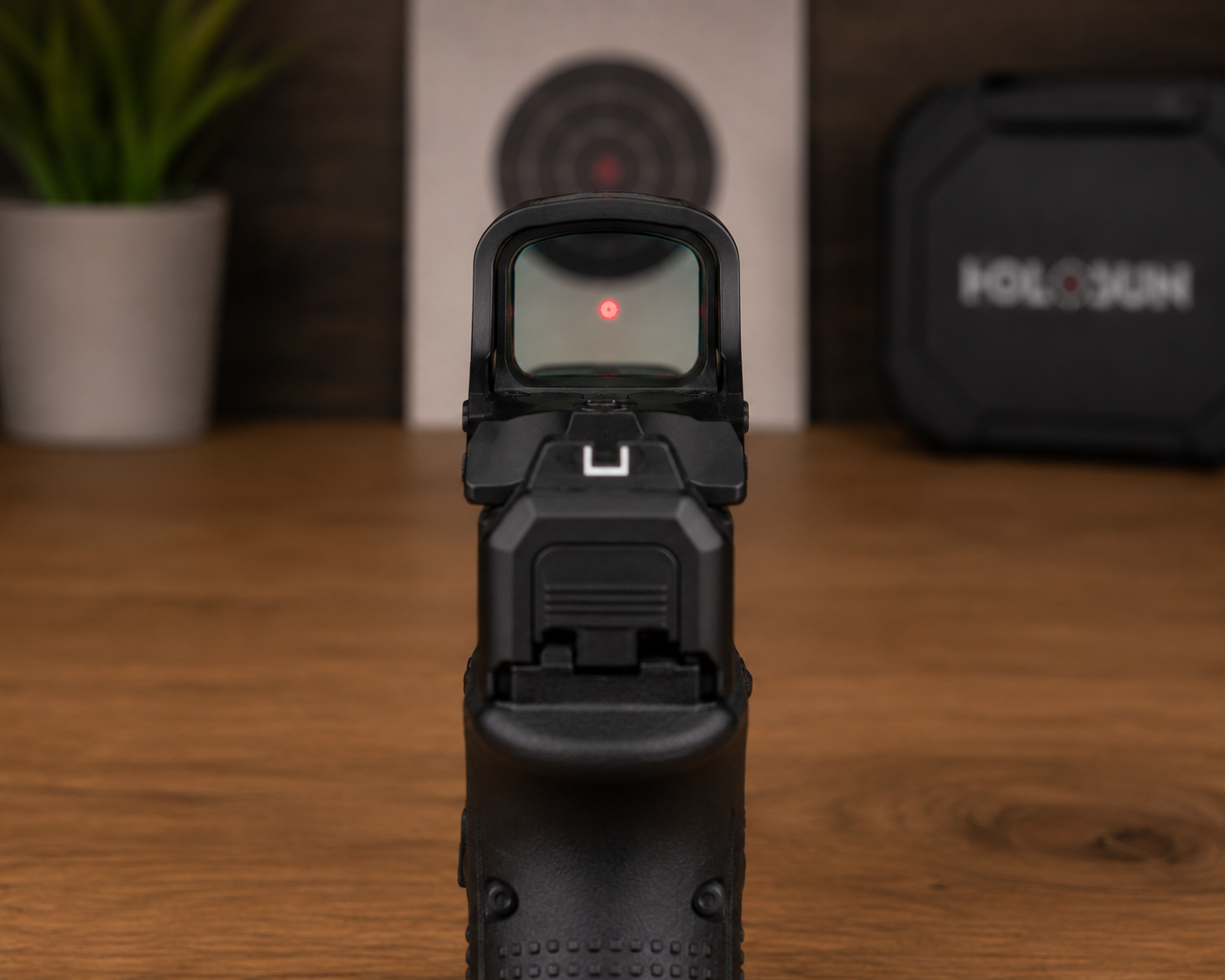
And it's a problem that even skilled handgun shooters struggle with. The Special Forces guy I talked to about this said he usually has this problem when the target is small and far away: "it feels like a 'I need to double check and make sure this thing is in the right spot'".
At first glance, this is confusing. Because we have to look at the sight in order to aim. That's what it's there for. It'd be irrational to not look at the sight, because that's "aiming by hope".
At least, it sure doesn't seem like looking at the thing that tells you how your aim is off should be a problem.
His response: "It doesn't, right? But for some reason it has a big effect"
The answer lies in active inference. The way we aim at a target is by expecting the dot to show up on target and then acting so as to realize this expectation. The act of controlling something changes where it is, and so an optimal unsaturated controller (one with enough authority to correct errors as fast as it sees them) will always expect the controlled variable to end up exactly where it wants — for if you expected to miss to the left you would steer right until a miss to the left is just as surprising as a miss to the right. More than that, you expect it to be there right now, in the proximal timestep, because if you have the oomph to fix the problem right now you fix the problem right now.1
As a result, the way to aim, technically, is by looking right at the center of the target, predicting "Dot here!", and then moving so as to realize that expectation. If you're actually aiming at the target, the place you will look to find the dot is on target. Because if the dot is going to be found on the target, then there's only one place to look — everything of interest is going to be at the target. That's why competitive shooters have come around to the idea that good shooting is target focused.2
And that's why looking at the dot is a problem. It means you're not actually aiming. So of course it has a big effect.
"Expect the dot to show up on target" is easier said than done. "Expecting" and "Declaring that one expects" are not the same thing. In order to actually aim at the target, one has to actually anticipate that the dot will end up there. If you say "The dot will be on target!" and someone doubts you "Will it, though?", it has to feel like they just doubted you when you told them you have a belly button: "Yeah. I literally just told you."
And if it doesn't, that stands out because you were focusing on an expectation that's being falsified.
So what happens?
"John is going to be here any minute". When he doesn't show up, and it's dragged on long enough that "any minute now" is no longer feeling so true... "What the heck happened to John. Where is he?"
Looking for the dot is perfectly rational, when you cannot hold the expectation. If you don't know where the dot is, you don't know where to steer it to get it onto the target, so that's probably not going to happen. Not until you find the damn dot. Where's the dot?
Or if you need to hit a small target far away, and you doubt your ability to do it — at least, with high enough reliability. Of course you find yourself checking. Because you need to double check and make sure this thing is in the right spot. And if it's not, maybe do something different.
If you're predicting for the dot to be in a small area and keep finding that it's not, you have a few options.
Continue to predict that the dot will be precisely on target, next timestep. Ignore the evidence that "You didn't just get unlucky. You're not capable". So long as you don't notice that you aren't capable, you'll keep your hope, and with it your ability to keep trying. It will be delusional hope, and your efforts will probably continue to fail, but hey, at least you're trying. When truth comes knocking you can always grit your teeth and exert your will to not notice your dissatisfaction with your chances of success. At least, until you notice how likely this strategy is to pan out for you.
Give up on precision, keep the control that you can have right now. Predict that it'll be somewhere around there. Relax the precision of your expectations until reality fits. I mean, my skill is what it is. I'll grade my performance after the competition is over. This is perfectly appropriate when what matters is hitting these targets, rather than learning to hit future targets.
Keep the precision, give up the control. "Dot here!" becomes "Dot where?", so that you can actually expect to succeed in "Dot here!" — where "here" now just means "wherever you happened to find it", not "on target", necessarily.
Staring at the dot happens naturally any time we try to do something beyond our current capabilities, and hold on to that precision as we engage with the reality of what's happening.
Sometimes we're with it enough that we glance at the dot, rather than staring.
"Yeah, I mean, I don't know for sure that I'm gonna hit the bad guy and not the hostage right next to him. Can I afford this risk? Fuck it. Send it"
"Where the heck is the dot?? Oh, there it is. Onto the target you go!"
The difference between a glance (functional) and a stare (dysfunctional) isn't duration, it's function. The question isn't "is two seconds too long" it's "Is this looking in service of doing?". Can you articulate "I am looking to find X to precision Y, and the moment I have it I will use it to do Z"?
So long as it's "As soon as I see the dot in the window, I will put it on target", then there's no problem. It might take ten minutes if the problem is the battery is dead. But so long as "Dot will be on target" fails to "Where is dot?" fails to "Who has a spare battery for me?", then the failures are graceful, and lead back onto target the moment we find a solution to the real problem.
We don't always manage this degradation of our ability to expect gracefully. Sometimes we just stare. "Oh man, look how fucked we are. This is not good". We rationalize. These rationalizations can be very very compelling. Because, like, we have to know where the dot is in order to aim! It'd be irrational to not look at the dot! Right?
And so we stare — even after we've found the dot. This trap is very very subtle, and traps even smart people with sincere intent and great disinterest in being deluded.
At least, I'd like to believe. Because as I mentioned, it caught me on the meta level even as I was thinking about this problem.
So what do we do about this? How do we make sure we only glance at the dot, and keep our object level aim on the actual thing?
You might have heard the saying "Aim small, miss small". In lay speak, it means to aim at a small part of the center specifically, and not be satisfied "aiming at the whole thing". Which is a kinda confusing concept on a technical level, since if I knew I was more likely to err left than I were to err right, I'd aim right until that were no longer true. Isn't that aiming at an infinitely small point?
No, because the width of my probability distribution isn't zero. Even if you center the distribution so that you are no more likely to miss left than right, you anticipate having a certain spread in results, and this is the size of your aim. The saying "aim small miss small" is about expecting the shots to actually arrive right next to each other. Which is confusing still, because don't you just aim to the best of your ability and find out where they land? How does expecting a narrow distribution actually change the distribution?
Active inference, again. So long as you're "on target" your expectation is fulfilled so there's nothing motivating action. More technically, it's about the gain of the controller. In Expectation = intention = setpoint I explained how an optimal unsaturated controller actually expects the system to be at the set point in the proximal future. There's another assumption in that model which is that the controller's self model is accurate. To the extent that it isn't, you can't just "correct the whole problem" in one timestep because the larger your correction, the larger the uncertainty you inject into the system by doing so.
Harris and Wolpert talk about the effects of this actuation noise in their paper "Signal-dependent noise determines motor planning", but the short version is that when you look at the total error, you have to decide what fraction of this error is "real correctible error" and what fraction is "my own noise, which would be counterproductive to chase". If the actual information theoretic limits put you at about an rms error of 1 degree and you find yourself 10 degrees off, then something real probably happened (maybe someone poured ice on the thing you're trying to heat) so go ahead and fix it by applying heat like it's mostly real. If you're 0.1 degrees off, and you try to slam on full power to fix that in 100ms, you're likely adding more error than you're fixing, so the appropriate response is to do little, like it's mostly not real. The question at every timestep is whose error this is — the world's? Or mine? What can you actually expect to correct?
This gives us a concrete way of thinking about whether we're "aiming too big" or "aiming too small". Aiming too big is when you're not really trying because you could hit a smaller target if you actually tried. Aiming too small is when you try to do better than your actual constraints allow.3 Not only does this result in worse short term results as you inject noise chasing noise, aiming too small is also the thing that pulls you towards looking at the dot. Because trying to aim smaller than your own noise floor means your prediction is guaranteed to keep getting falsified, at a rate no amount of steering can fix — you can't correct variance you yourself are injecting. So you're stuck permanently in the "John should be here by now" condition, and chronic falsification forces you into one of the three options. The more reality pries against your tight grip, and the more you try fight against letting go, the more you're left a tight grip on a floating dot — and if you don't notice, you end up staring at that dot.4
So the best way to aim is to aim as small as you actually can, and no smaller.
"How small can you aim?" is an empirical question. Find out, by actually trying to hit a small target, and noticing when your attention starts to get tugged from the target to the dot.
Right?
So yes, when your goal is to hit that target.
But here's the twist.
When your goal is to learn how to aim well, so that you can hit a future target that matters, "finding out how small I can aim" is staring at the meta dot.
Because "How small can I aim" is a direct result of how far off your actuation model is. And what we want to do when training isn't to learn how big our model error is, but to drive it to zero. Aim for it to be not wrong.
It's the same trichotomy, one level up.5
One subskill that's important in practical shooting is "index" — basically, how well can you point the thing based on feel alone, so that the dot shows up close enough that you don't have to go looking for it. When training index, if you find yourself focused on "How far off is my proprioceptive index?", you're staring at the dot. You may be learning how small you can currently aim, as of the last timestep, but you're not learning index. Do you want to update your estimate of the model's quality, or do you want to update the model?
This is the failure which motivated the thought behind this post. "Okay, I want to get better at index. So I should practice. Okay, that didn't work. How far off was I, and in what direction? That's what I need to look at... right?". Only I could tell that this didn't really connect. Okay, so I was pretty far off, and in this direction. I knew that, but I could feel my body not updating — or rather, I couldn't feel my body updating. I didn't feel more skillful after, so I knew something was wrong.
In hindsight, I was staring at the meta dot. I wanted to be better at this than I was, I noticed that I wasn't good enough, and so looked at the meta dot instead of accepting "eh, good enough", and then didn't see how to get back on track.
The track I was looking for, the question that actually improves this subskill, is the one that improves your self model. Not "How far off is my proprioceptive index?", but "What does it feel like, in my arms/wrists/etc, to be pointing the gun such that the dot shows up centered in the window and on target".
"What does right feel like?"
This stuff is everywhere.
After figuring this out, I wanted to see if I could teach my wife how to learn the skill of "index" quickly, and before we could finish she started getting distracted by allergies — or, what she thought were allergies.
"Are you sure this is allergies? You're sure you're not getting a cold?"
"I don't know"
"I mean, of course we can't know, but like... is that what you think?"
"I don't know".
Staring at the dot. It's everywhere.
Any time there's a variable you keep measuring, keep being displeased with the result, and then aren't surprised next time because you never genuinely expected to drive it to the desired value, you're staring at the dot.
"I want to know. I notice that I don't know. I wish I knew" — and not doing anything about it, because you never said this part out loud to yourself.
If the aim is to accurately distinguish real infectious threats from that-which-requires-no-immune-response, then expecting to actually know which one it is is expecting to do the hard thing of distinguishing reliably. And when we can't expect to do that, of course we shift our attention to the dot. And so we fail to even do the best job we can at figuring out what to do in our situation — like "Hm. I'm not sure. But I should probably take a nap because maybe my body needs it either way".
As an interesting aside, if our minds and body were actually connected, you'd expect "This is just allergies not a cold, so I don't need to immune response against this" to result in a decrease in allergic response itself. That's obviously a pretty kooky idea, but it's an empirically testable kooky idea, and the downside of testing is literally zero because "Am I getting sick or not?" is exactly what you gotta do anyway if you want to place coherent bets on how to respond in the ways you know you can control.
The most obvious sign that you or someone else is staring at the dot is that it's staring.
"Oh shoot, I missed the turn" is life. It happens. Skillful navigating gets us right back on track to expecting for realsies to actually get where we need to go. Expecting to get there because we noticed and are therefore correcting for the initial turn.
"Man, I keep missing the turn" is staring. It's expecting to miss the turn again, instead of getting there efficiently, with more focus on how far off you are than on driving that error to zero. Why do you think you're doing that?
When you think about the things where you're up against your limits, trying at things that are not at all easy for you, where success is by no means a given... do you actually see yourself succeeding, in the end? For realsies, because you're learning and implementing all the things you can possibly find?
Or are you anticipating failure, explicitly or kinda begrudgingly, and not paying too much attention to that because "not like there's anything I can do about it. Some things are just beyond what I can do, and the only thing I can do is try and find out"?
Because if you "expect to fail" but "are gonna try anyway", then it means your curiosity isn't connecting in the ways that you could actually see working. Like when I was staring at the index error, instead of knowing that I was gonna get good eventually and wondering what that's gonna feel like so that I can get there sooner rather than later.
It means you're staring at the dot, and not aiming at what you care about.
You can relax your grip, and accept looser results, and you will get more of what you care about. Not everything you've ever wanted, and that's what you want. Because if you never butt up against "can't aim this small" you were never aiming for what you could.
Or you can glance at the dot in service of figuring out what right feels like, and if you can figure it out, you might do even better.
Or you can grit your teeth and bet that past failures won't repeat again, while you expect to lose the bet.
Them's the options.
Glancing at the dot is a necessary part of learning.
Staring at the dot means that the most interesting things remain unseen.
Notes
Interestingly, for a long time the dogma was to focus on the front sight. This is because you really do need to accurately perceive sight alignment in order to hit accurately, and iron sights are a lot harder to read than red dot sights. Not only do you have to judge relative positioning of the sights to target, but also the front sight to rear sight, and the sights are on their own focal planes. This makes the conditions that allow target focus to work much more challenging to achieve because it's a lot harder to predict the shots will land on target when it's harder to see what the sights are doing without focusing your attention on them. So of course people notice the reason to look at the front sight. I suspect that the reason that top shooters are teaching target focus with irons has to do with red dot sights making it that much more obvious that target focus is the way to go once you build the capacity to do it. See this video and this video. ↩
Interestingly, "Don't try to shoot more precisely than you actually can" is advice I've given a new shooter before having this framework to explain it. It worked quite well. ↩
There's a sneaky asymmetry here. Aiming too small leads to a trap, but at least it's a trap that leaves clear signs. You're looking at the dot, not the target. Your results aren't what you want, and you feel that. You might not know the way out, and might rationalize that you're doing the best thing when you're not, but at least once a solution presents itself you'll notice. You'll feel the tug. Aiming too big, on the other hand, leaves no such signs. Your predictions are always confirmed, you hit the easy targets you're aiming for, and everything is comfortable. The only sign here, is what you're not seeing. "What would it be like if you could hit more difficult targets?" ↩
This is where the tension comes from between "winning practice" and "getting better". If you're focused on getting the dot on target as close as possible as fast as possible, you are taking your current model as given and therefore not improving it. If you are focused on improving the model you will do things that expose the errors so they can be corrected, which is an error if it's this target you're trying to hit, not some future target that matters more. ↩